SSC CGL level Solution Set 71 on number system 10
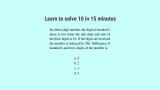
Learn to solve 10 number system questions for SSC Set 71 in 15 minutes using basic concepts and advance problem solving techniques. But take the test first.
Question sets and Solution sets on all topics for SSC CGL test. Quick concept based solutions embody systematic and quick problem solving in maths.
Solutions for the question sets form the most valuable component as each problem is solved in only a few steps by problem solving techniques.
Extensive and complete coverage. Largest component of the website.
Can be used for other similar competitive exams as well.
Learn to solve 10 number system questions for SSC Set 71 in 15 minutes using basic concepts and advance problem solving techniques. But take the test first.
Solve 10 number system questions for SSC in 15 minutes. Verify correctness from answers. Learn to solve quickly from paired solution set.
![]()
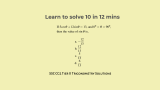
Solution to Surds and Fraction Questions for SSC CGL Set 70 explains how to solve the 10 surds and fractions questions quickly. But take the test first.
![]()
Carefully chosen surds questions and fraction questions for SSC CGL are to be solved 10 in 12 minutes. Verify from answers and learn to solve from solution.
You'll know what is Componendo dividendo, the proportion based simplification method, and how best to use the method to answer difficult questions quickly.
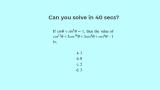
Trigonometry Questions with Solutions for SSC CGL Tier 2 Set 12 explains how 10 difficult trigonometry questions can be solved in 12 minutes' time.
Solve 10 selected Trigonometry questions for SSC CGL Tier 2 Set 12 in 12 minutes. Verify your score from answers and learn to solve quickly from solutions.
![]()
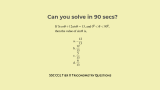
The 11th set of SSC CGL Tier 2 Trigonometry solutions explains lucidly how to solve quickly the 10 selected questions in 12 minutes time.
![]()
Solve 10 selected questions in SSC CGL Tier 2 trigonometry questions set 11 in 12 minutes. Verify results from given answers. Learn to solve from solutions.
A systematic event occurs at intervals, changing problem parameters. The challenge is to find the boundary before the event's full impact occurs.